

News
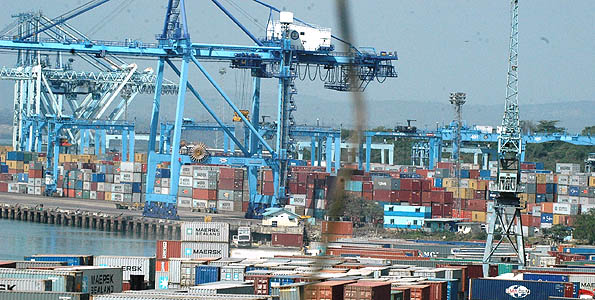
Countries that connect to the rest of the world through Kenya have launched an electronic platform to monitor cargo clearance online at the port of Mombasa, hoping to pile pressure on officials to cut delays.
The northern corridor transport observatory project launched in Mombasa on Thursday will also monitor speed of clearance by customs, standards bodies and weighbridges of member countries.
Under the project, a data centre based at Mombasa headquarters of Northern Corridor Transit Transport Coordination Authority (TTCA) will be collecting information detailing time spent at every agency.
At the port of Mombasa, the project seeks to reduce cargo dwell time (time taken from arrival to discharge of container) from 10 days to just one day, a council of Regional Affairs and Transport ministers said Thursday.
“This project is a key tool towards improving the performance of the Northern Corridor” said Abraham James Byandala, Uganda's Works and Transport minister and chairman of TTCA Council of Ministers.
Northern Corridor links Kenya with most of the landlocked countries in the region like Uganda, Rwanda, Burundi and DR Congo.
While the countries have formed the Mombasa-headquartered Northern Corridor Transit Transport Coordination Authority (TTCA) to boost flow of imports and exports, traders still encounter barriers.
The council of ministers admitted South Sudan to the secretariat that runs TTCA Thursday, meaning only Ethiopia and Tanzania are major users of the corridor not represented at the intergovernmental body.
Available data shows that the corridor handles 21.5 million tonnes of cargo every year. Only 12.5 million of this is destined to Kenya will the rest on transit to other countries. With under performing rail system, 95 per cent of this cargo is ferried on roads, leading to delays at weighbridges in a region which prescribes different national weight limits.
At the ceremony to launch the observatory, players criticised the use of regulatory agencies are primary information source saying this could compromise data integrity.
But TradeMark East Africa (TMEA) and the Kenya Transporters Association (KTA) which are sponsoring the project maintained that the GPS-based initiative will improve trade and policy formulation.
“Through the observatory data, it will be possible to identify bottlenecks and choke points on the Northern Corridor,” said Mr David Stanton, TMEA’s deputy CEO in charge of country programmes.
The project seeking to speed up movement of goods comes just months after Rwanda became the first country in the region to launch single electronic window system that once completed will also cut documentation related to imports and exports.
Kenya has also begun to roll out its single electronic window system after receiving funding from Investment Climate Facility last week.
“The Transport observatory is critical as an operational tool for monitoring corridor performance as problems that cannot be measured are extremely hard to find solutions for.” said Mr Stanton.
In its five-year strategic plan released Thursday, TTCA says its key focus would be to reduce cost of doing business on the Northern Corridor through harmonisation of transport policies and regulations and simplification of trade procedures.

Effective 1 January 2019, the electronic Air Waybill (eAWB) will become the default contract of carriage for all air cargo shipments on enabled trade lanes.
This key industry milestone ushers air cargo
into a new era where digital processes will be the norm and paper processes will be the exception. eAWB brings numerous benefits such as:
- Elimination of paper based processes
- Improved efficiency and reliability of the overall cargo handling process
- Faster delivery times
- Decrease handling errors
- Positive impact on the environment with reduced paper usage
IATA introduced eAWB in 2010 with the objective to initiate the digitalization of the air cargo supply
chan.Ever since, the eAWB initiative has been a key enabler to the digitalization and transformation of
Our industry, as data availability and quality is critical to deliver innovative solutions and enhance customer experience. The growing number of stakeholders using eAWB demonstrates that the industry is ready ad committed to embrace the full digitalization of the air cargo industry.
IATA encourages all air cargo industry stakeholders to switch to eAWB at the earliest unless a paper air waybill may still be required due to applicable international treaties, national law, or as bilaterally
agreed between the parties. You will find all necessary information for implementing eAWB in the IATA eAWB Implementation Playbook.For specific questions, please contact your local airline representative. for general information on eAWB, visit www.iata.org/eawb.

They were also accused of failing to seal inspected containers, which Kenya says was done to facilitate entry of sub-standard and illicit goods. The two firms inspect goods in China, Indonesia, Malaysia, Vietnam and Thailand before they are loaded ready for transportation into the Kenyan market.
The CCIC and SGS violated provisions of the legal notice 127 of 128, which requires all inspection agents the Kenya Bureau of Standards (Kebs) appoints to issue certificates of conformity in respect to goods that meet the relevant Kenyan standards.
Industry, Trade and Co-operatives secretary Peter Munya said the fine was in millions of shillings but declined to give an exact figure.
“In the face of significant non-performance, the government has suspended activities of the two companies. The bans take place immediately and have been instituted to enable the affected companies put in place corrective measures,” he said yesterday.
Mr Munya added that the government is reviewing the law to include criminal sanctions on any contracted party that violates the contractual obligations and occasions harm to the public using these products.
The Kebs contracted the two companies alongside Cotecna Inspection SA, Bureau Veritas, Intertek International Ltd to inspect goods destined to Kenya from across the globe under the Pre-Export Verification on Conformity programme.
Under the new procedure created in 2005, all consolidated cargo must be inspected in the country of origin by the Kebs-appointed inspection agents and issued with a certificate of inspection before imported to Kenya.
The suspension comes as the government steps up efforts to stem the flow of illicit and sub-standard products into the local market.
The government in April warned that any firm found dealing with contraband products will be blacklisted and its officials outlawed from conducting any business at the Mombasa port